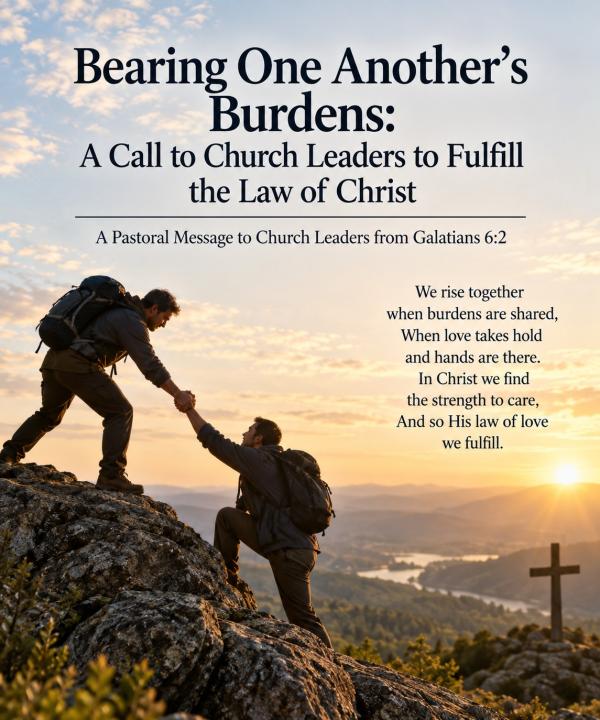
A Call to Church Leaders to Fulfill the Law of Christ
A Pastoral Message to Church Leaders from Galatians 6:2
“Carry one another’s burdens, and in this way you will fulfill the law of Christ.” — Galatians 6:2
To those entrusted with the sacred responsibility of leading Christ’s church, Galatians 6:2 offers a vision of ministry that is both wonderfully simple and profoundly demanding: “Carry one another’s burdens, and in this way you will fulfill the law of Christ.” These words remind every pastor, elder, teacher, ministry leader, and servant of the church that Christian leadership is never merely the management of ministries, the organization of programs, or the communication of biblical information. At its deepest level, spiritual leadership is participation in the burden-bearing love of Jesus Christ.
The church is not a gathering of people who have no burdens. It is a community of people learning to carry their burdens together beneath the grace of Christ.
Every congregation contains burdens that are visible and burdens that remain hidden. Some people carry grief. Some carry financial uncertainty. Some carry broken relationships. Some are caring for aging parents. Some are raising children through difficult seasons. Some are wrestling with temptation. Some are exhausted by responsibilities that few people recognize. Some are walking through disappointment, loneliness, confusion, or spiritual dryness. Some appear strong while quietly struggling beneath pressures they have never spoken aloud.
Church leaders are called to cultivate communities where such burdens do not have to be carried alone.
Paul’s command in Galatians 6:2 appears within a larger discussion about life in the Spirit. Near the end of Galatians, Paul describes what freedom in Christ actually looks like when it becomes visible in relationships. Christian freedom is not independence from other people. It is freedom from self-centeredness so that believers can serve one another in love.
This is especially important for church leaders.
Leadership can easily become associated with platforms, influence, vision, strategy, preaching ability, organizational skill, or measurable growth. These things may have their place, but none of them defines the heart of Christian leadership. Jesus gave the church a radically different picture of greatness.
He listened to the forgotten.
He wept with the grieving.
And ultimately, He carried the greatest burden humanity could never carry for itself.
At the cross, Christ bore our sin.
The burden-bearing ministry of the church therefore flows from the burden-bearing work of Christ. Christians carry one another because Christ first carried them. Christian compassion is not merely humanitarian kindness. It is the reflection of the gospel itself.
Paul says that by carrying one another’s burdens believers “fulfill the law of Christ.”
The expression points toward the command that summarizes the life Christ calls His people to live: love one another. Jesus told His disciples, “Love one another. As I have loved you, so also you must love one another.” The measure of Christian love is therefore not simply human affection or natural sympathy. Its measure is Christ Himself.
Those words transform the meaning of ministry.
Christ did not love from a safe distance. He entered human suffering. The eternal Word became flesh and dwelt among us. The Son of God entered weakness, rejection, sorrow, exhaustion, temptation, misunderstanding, betrayal, suffering, and death.
The incarnation itself reveals something about the character of divine love: God comes near.
Church leaders who fulfill the law of Christ must therefore become leaders who are willing to come near.
This does not mean that leaders must personally solve every problem in the congregation. No human being has the capacity to carry every burden personally. Attempting to do so often leads to exhaustion, unhealthy dependence, and eventually burnout.
Instead, leaders are called to create a culture in which the entire body learns to carry burdens together.
Galatians 6:2 does not say, “Pastors, carry everyone’s burdens.”
It says, “Carry one another’s burdens.”
The command belongs to the whole church.
One of the most important responsibilities of spiritual leadership, therefore, is not simply to carry burdens but to teach the church how to become a burden-bearing community.
A healthy congregation should increasingly become a place where people notice one another.
Where someone recognizes when a widow has been absent.
Where someone calls the family going through hardship.
Where meals arrive when sickness enters a home.
Where young believers find mature Christians willing to walk beside them.
Where struggling marriages find wise counsel and compassionate support.
Where people battling temptation can confess their struggles without immediately fearing humiliation.
Where grief is not rushed.
Where weakness is not treated as failure.
Where those who fall are restored gently.
Where practical needs are noticed alongside spiritual needs.
Where prayer becomes more than a phrase spoken after hearing someone’s difficulty.
This kind of church does not emerge accidentally. Leaders must model it, teach it, encourage it, and protect it.
The immediate context of Galatians 6 makes this especially clear. Paul has just written that if someone is caught in a transgression, those who are spiritual should restore that person gently while watching themselves so that they are not also tempted.
Then comes the command to carry one another’s burdens.
This means burden-bearing includes helping people who are struggling spiritually.
Church leadership must therefore learn the difference between restoration and condemnation.
When someone falls into sin, the church must take sin seriously. Grace never requires pretending that destructive behavior is harmless. But biblical seriousness about sin is always joined to a desire for restoration.
The goal is not humiliation.
The goal is not to prove that the church is morally superior.
The goal is to help the wandering return to Christ.
The goal is not to crush the wounded.
The goal is to help them stand again.
Leaders should remember how easily religious communities can become places where people hide their struggles because they fear what will happen if anyone discovers them. When churches cultivate appearances rather than grace, people become skilled at presenting themselves as spiritually healthy while suffering privately.
A burden-bearing church creates a different atmosphere.
It says that truth matters and grace is available.
It says repentance is necessary and restoration is possible.
It says failure has consequences, but failure does not place a repentant person beyond the reach of Christ.
It says the church is not a museum displaying flawless saints but a living community being transformed by grace.
Church leaders must model this humility.
The temptation of leadership is to create the appearance of spiritual invulnerability. Leaders may feel pressure to appear continually strong, continually certain, continually energized, and continually victorious.
But Scripture does not present spiritual maturity as pretending weakness does not exist.
Paul openly acknowledged weakness. He described hardship, persecution, discouragement, and dependence upon God. Yet these acknowledgments did not weaken his ministry. They revealed the source of its strength.
The church does not need leaders who pretend they never carry burdens.
The church needs leaders who know where burdens belong.
They belong beneath the grace of Christ and within the fellowship of His people.
There is also an important distinction between carrying burdens and assuming responsibilities that belong to someone else. Later in the same passage, Paul says that each person should carry their own load. These statements are not contradictory.
There are responsibilities each believer must carry before God. No leader can repent for another person. No pastor can obey Christ in someone else’s place. No elder can develop another person’s prayer life for them. No ministry team can make someone surrender to God.
But there are burdens that become too heavy for someone to carry alone.
Christian wisdom learns the difference.
Healthy ministry does not create dependency. It creates community.
It does not remove personal responsibility. It surrounds personal responsibility with grace.
It does not rescue people from every difficulty. Sometimes hardship is precisely where God is forming endurance, wisdom, humility, and faith.
Burden-bearing means refusing to let people walk through such places alone.
Church leaders should therefore ask not only, “What ministries are we running?” but also, “What burdens are our people carrying?”
That question may reveal needs that attendance statistics cannot measure.
A congregation can appear successful while people within it are quietly collapsing beneath loneliness.
A church calendar can be full while relationships remain shallow.
A ministry can have excellent production while wounded people remain unseen.
A congregation can celebrate numerical growth while exhausted volunteers slowly lose their joy.
The kingdom of God cannot be measured only by visible activity.
Leaders must learn to see people.
Jesus consistently did this.
Crowds surrounded Him, yet He noticed individuals.
He noticed Zacchaeus in the tree.
He noticed the woman who touched His garment.
He noticed blind Bartimaeus crying beside the road.
He noticed the widow placing her offering in the temple treasury.
He noticed Mary weeping at His feet.
He noticed Peter after Peter denied Him.
Christ’s ministry reveals divine attentiveness.
Pastoral leadership should reflect that attentiveness.
Sometimes carrying a burden begins with simply noticing.
A leader notices that someone who was once joyful has become quiet.
A small-group leader notices that someone repeatedly asks for prayer without explaining why.
An elder notices that a caregiver looks exhausted.
A youth leader notices that a teenager who normally participates has withdrawn.
A pastor notices that a faithful volunteer has begun serving without joy.
Compassion begins when people stop becoming background scenery.
But noticing must be followed by presence.
Many burdens cannot be solved with quick answers.
Grief cannot always be explained.
Chronic illness cannot always be fixed.
Family conflict may take years to heal.
Financial difficulty may not disappear after one prayer.
Questions about faith may remain unresolved for a season.
In these situations, the church offers something deeply Christian: faithful presence.
Sometimes the most pastoral words are simply, “You do not have to walk through this alone.”
This is not an empty promise when the body of Christ actually lives it.
Leaders should resist the pressure to provide immediate explanations for every suffering person. Job’s friends were most helpful when they sat silently beside him. Their greatest failures began when they felt compelled to explain what they did not understand.
People carrying heavy burdens often need companionship before explanation.
They need prayer before analysis.
They need listening before instruction.
They need to encounter the patience of Christ through the patience of His people.
This requires churches to slow down enough for relationships to become real.
Programs can gather people, but programs cannot replace community.
Sermons can teach compassion, but sermons alone cannot practice compassion.
Vision statements can describe love, but love must eventually take human form.
Someone must make the phone call.
Someone must visit the hospital.
Someone must sit beside the grieving.
Someone must bring the meal.
Someone must pray through the night.
Someone must mentor the struggling believer.
Someone must help carry the burden.
Church leaders are called to build ministries where these ordinary acts of grace are understood as sacred kingdom work.
Much of the most important ministry in a congregation will never appear on a platform.
There will be no applause for many acts of Christian faithfulness.
No congregation may hear about them.
No social media post may celebrate them.
When a believer quietly walks beside another believer through a difficult season, the law of Christ is being fulfilled.
When someone sacrifices time to care for the lonely, the law of Christ is being fulfilled.
When a mature Christian gently restores someone who has fallen, the law of Christ is being fulfilled.
When a congregation surrounds a grieving family with prayer, meals, presence, and compassion, the law of Christ is being fulfilled.
When leaders protect exhausted servants from being consumed by ministry expectations, the law of Christ is being fulfilled.
This last point deserves special attention.
Church leaders must remember that the people serving in ministry are not merely resources for accomplishing the church’s mission. They are sheep entrusted to the care of Christ’s shepherds.
Staff members have burdens.
Missionaries have burdens.
Worship leaders have burdens.
Children’s ministry workers have burdens.
Those who serve others must also be allowed to receive care.
A church can unintentionally become a place where faithful people are continually asked to give without anyone noticing when they are becoming empty.
Wise leaders watch for this.
Sometimes burden-bearing means giving someone permission to rest.
Sometimes it means reducing expectations.
Sometimes it means saying, “Your value here is not determined by how much you produce.”
That truth is deeply theological.
The gospel declares that human worth is not earned through performance. Christians are received by God through grace. Their identity rests in Christ, not in productivity.
Church culture should reflect the gospel it proclaims.
Leaders must also carry burdens across differences.
The command says, “one another.”
That includes people who are easy to understand and people who are difficult to understand.
People from different generations.
Different economic circumstances.
Different levels of spiritual maturity.
The church becomes a visible testimony to the gospel when people who might otherwise remain separated learn to care for one another because they belong to Christ.
Burden-bearing therefore becomes a form of witness.
Jesus said the world would recognize His disciples by their love for one another.
Imagine what communities might see when churches become known not merely for what they believe but for how deeply they care.
Imagine congregations where lonely people find family.
Where struggling parents find support.
Where young people find mentors.
Where older believers are honored rather than forgotten.
Where people recovering from failure find restoration.
Where the poor are treated with dignity.
Where the grieving find companions.
Where leaders are accessible enough to notice pain and wise enough to mobilize the body to respond.
Such a church becomes a living picture of the gospel.
And leaders must remember that they cannot create this culture through instruction alone.
People learn what a church values by watching what its leaders celebrate.
If leaders celebrate only growth, people will pursue growth.
If leaders celebrate visibility, people will pursue visibility.
If leaders celebrate talent, people will pursue recognition.
But if leaders celebrate compassion, service, faithfulness, humility, generosity, restoration, and quiet acts of love, the congregation begins to understand what greatness looks like in the kingdom of God.
The church must continually return to Jesus.
He is the great burden-bearer.
Isaiah spoke prophetically of the Servant who would carry our sorrows. The Gospels reveal the fulfillment of that promise in Christ. At Calvary, Jesus carried the burden no human community could carry for itself.
And through His resurrection He opened the way into new creation.
Therefore, when Christians carry one another’s burdens, they are not replacing Christ. They are reflecting Him.
Every act of Christian compassion points beyond itself toward the One who carried us first.
Church leaders must keep this gospel center clear. Otherwise burden-bearing can become mere activism and eventually exhaustion.
The church does not carry burdens through unlimited human strength.
It carries burdens because Christ carries the church.
Ministry leaders are not saviors.
This truth brings both humility and freedom.
Leaders can serve deeply without imagining that everything depends upon them.
They can love faithfully while acknowledging their limitations.
They can trust Christ with situations they cannot fix.
The strongest leadership is not leadership that carries everything alone. It is leadership that continually brings the burdens of the church before the throne of grace.
Prayer is therefore essential to burden-bearing ministry.
When leaders hear the pain of their people, they should carry those names into prayer.
When circumstances exceed human wisdom, they should seek divine wisdom.
When suffering cannot be removed, they should ask God for sustaining grace.
When relationships fracture, they should pray for reconciliation.
When people wander, they should pray for restoration.
When ministry becomes heavy, they should remember Christ’s invitation to come to Him.
The church carries burdens best when it knows that beneath every human hand carrying another person is the everlasting strength of God.
Church leaders, let Galatians 6:2 shape the imagination of ministry.
Build churches where people are known.
Cultivate communities where weakness can be spoken without shame.
Teach believers to notice one another.
Equip mature Christians to walk beside those who struggle.
Restore the fallen gently.
Honor quiet acts of service.
Create structures of care, but never allow structures to replace relationships.
Preach grace, and then organize the life of the church so that grace becomes visible.
Above all, keep pointing the congregation toward Christ.
For every burden carried by the church ultimately rests beneath the greater burden carried by Jesus.
He carried our sin so that we might carry one another in love.
He entered our suffering so that we might enter the suffering of others with compassion.
He came near to us so that we might come near to one another.
He served us so that we might serve.
He forgave us so that we might restore.
He loved us so that we might love.
This is the sacred calling of spiritual leadership.
Not merely to build ministries, but to build a people who know how to love.
Not merely to gather crowds, but to cultivate community.
Not merely to preach compassion, but to embody it.
Not merely to teach the law of Christ, but to fulfill it.
And wherever the people of God kneel beside the weary, strengthen the weak, restore the fallen, comfort the grieving, support the struggling, and walk faithfully beside one another, the cruciform love of Jesus becomes visible.
So carry one another’s burdens.
Teach the church to carry them together. And when those burdens become heavier than human strength can bear, bring them together to Christ.
For the church belongs to Him.
The people belong to Him.
The ministry belongs to Him.
And beneath every burden carried in love stand the everlasting arms of the One who first carried us.